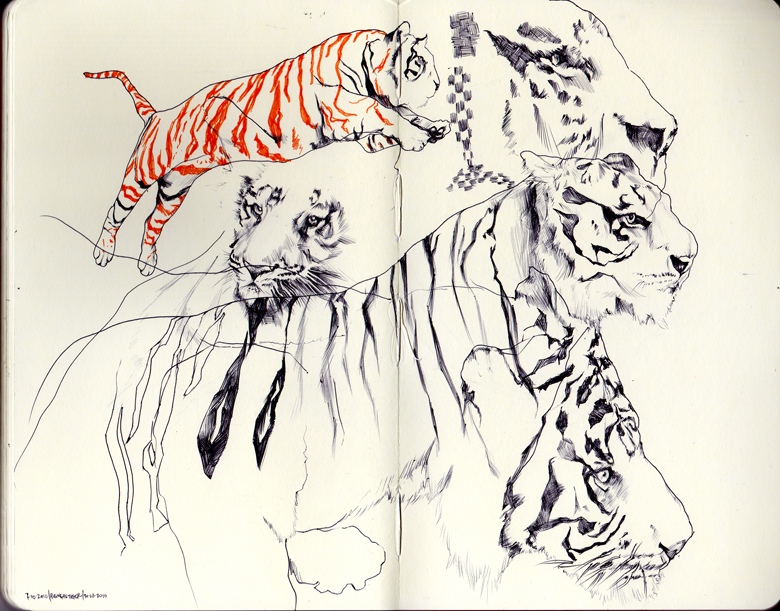
29 October 2011

bestiary: bengal tiger

as the names suggest, this engandered subspecies of the tiger family can be found in india. they're the largest of the cat family and unlike many a movie might suggest, they tend to avoid humans unless they're a bit mad. i wasn't aware that they hunt nocturnally. they're individiual down to their stripes and very independent, typically living alone as adults. males do not raise their cubs, yet females will raise their young until they're old enough to hunt. that usually takes about three years. i also didn't know that white tigers are recessive mutants of bengal tigers. the chinese seemed to prize tigers for their medicines but they were also poached largely as trophies for their fur. panthera tigris tigris in moleskine.

27 October 2011

we have the power

i don't bother with many contests but for some reason i like what the folks at positive posters are doing. they choose an issue each year and the competition involves designing a poster to spread awareness for that cause. the ideas are simple and the winning posters typically have been very simple. this year's brief allowed the entrants to choose their own cause. this seems like a first world problem at first but i chose the idea of energy and its conservation, use, renewal, sourcing, impacts, etc.
anyway, a simple light bulb printed in a particular way would sort of get across all the different angles i was thinking. the bulb would be printed with glow in the dark ink. the base would be printed with some sort of reflective or metallic ink. the light bulb itself is an obvious reference to energy i think but it's also a typical symbol of ideas or so-called light bulb moments.  all of this together would foster awareness in and remind viewers about energy conservation (the bulb is "uplugged" and it's glow is finite), use (the glow), alternatives (phospherescence "powers" the bulb), renewal (bright lights "charge" the bulb), etc.
it was nice to focus on something more conceptual considering that most of my work has been focused on the bestiary lately.

24 October 2011

bestiary: beluga whale

contrary to their name, these whales do not produce the caviar that seems to be so sought after. these are white whales. not the type that captain ahab was after though (sperm whale, in that case). they inhabit arctic waters but inhabit warmer waters when arctic oceans freeze over, lest they become food for polars bears or people. they're most notable because of their melons. seriously, the lump on their heads is referred to as a melon and is comprised of oily, fatty tissue. i'm not sure if this is some sort of survival related feature but belugas can change the shape of their heads by shifting air around in their sinuses. more survival related, they are among the only whales that can actually turn their heads. they lack dorsal fins in favour of dorsal ridges. delphinapterus leucas in moleskine.

16 October 2011

bestiary: beaver

say hello to canada's national animal. i never really thought about it like this but national geographic puts it well when they say that these rodents are engineers of sorts, chewing through trees to use for their dams and lodges (homes). it's interesting that they're considered rodents and yet they are not so nimble on land where most other rodents seem to be the most adept. their webbed feet and tails allow them to easily manoeuvre through rivers, lakes, and the ponds their dams create. more evidence that they seem built for the water: the can hold their breath for nearly 15 minutes and even have a set of transparent eyelids. they have built in goggles! i love it. they'll often build their lodges smack dab in the middle of a pond and make the entrance underwater. now that's what i call not wanting to be disturbed. castor canadensis in moleskine.

10 October 2011

bestiary: baltimore oriole

while most probably known for being the namesake of a certain professional baseball team, the baltimore oriole is also maryland's state bird. how did these omnivorous little guys get to be a state bird, you ask? well, i'll tell you. their colours closely matched the coat of arms of lord baltimore, cecil calvert. these orioles are migratory, leaving the eastern US and canada in favour of warmer climates in mexico and central / south america in the winter. icterus galbula on moleskine.

09 October 2011

thanks

i'm not going to go into why i think this man was so special - i think everyone has his/her own reason. his passing was quite surprising and unbelievable to me. here's my little tribute of thanks to mr. steven p. jobs. condolences to his family and friends.

a more detailed version:
  
and, of course, a white version:

04 October 2011

keeping things spicy

i have largely been working on the bestiary drawings but i miss other media. so, i'm going to throw in the odd experiment here and there for no good reason other than to provide some variety.

i have good days and bad days staring at this. i chose to self impose a basic colour combination and only paint in gradients. i'm going to try some other so called basic combinations as well. i'm going to guess they'll be ugly / uglier.

02 October 2011

bestiary: bald eagle

it's pretty common knowledge that white headed bald eagles are the national symbol of the united states but i had no idea that these birds of prey were nearly, er, extirpated (locally extinct) in the land of the free. hunting definitely had an effect on their numbers but the use of ddt (that showed up in the fish they ate) really sent their population in the u.s. in a nosedive. once ddt was banned though, the birds' numbers rebounded successfully. i also thought that being birds of prey, bald eagles only hunted for live animals but they do feed on carrion as well - sometimes the carcasses are those of whales! this and the fact that they have been known to bully food from away from other animals led ben franklin to vote against them as the american national symbol. these eagles are another example of animals that usually have one mate for life. they lay only a few eggs per year in their nests that are among the largest of any bird today. haliaeetus leucocephalus in moleskine.